OSINT Briefing Southwest 2
OSINT Briefing // Operational Sector: Moravian Gate – Ostrava Axis [49.834° N, 18.282° E]
Subject: Retrograde Movement of Polish 21st Division, Czech 7th BCT Border Screening, and Projected Ocassian Thrust Dynamics
Classification: Strategic Assessment / Order of Battle & Geospatial Funnel Analysis
Frontline Dislocation: The Polish 21st Division Corridor
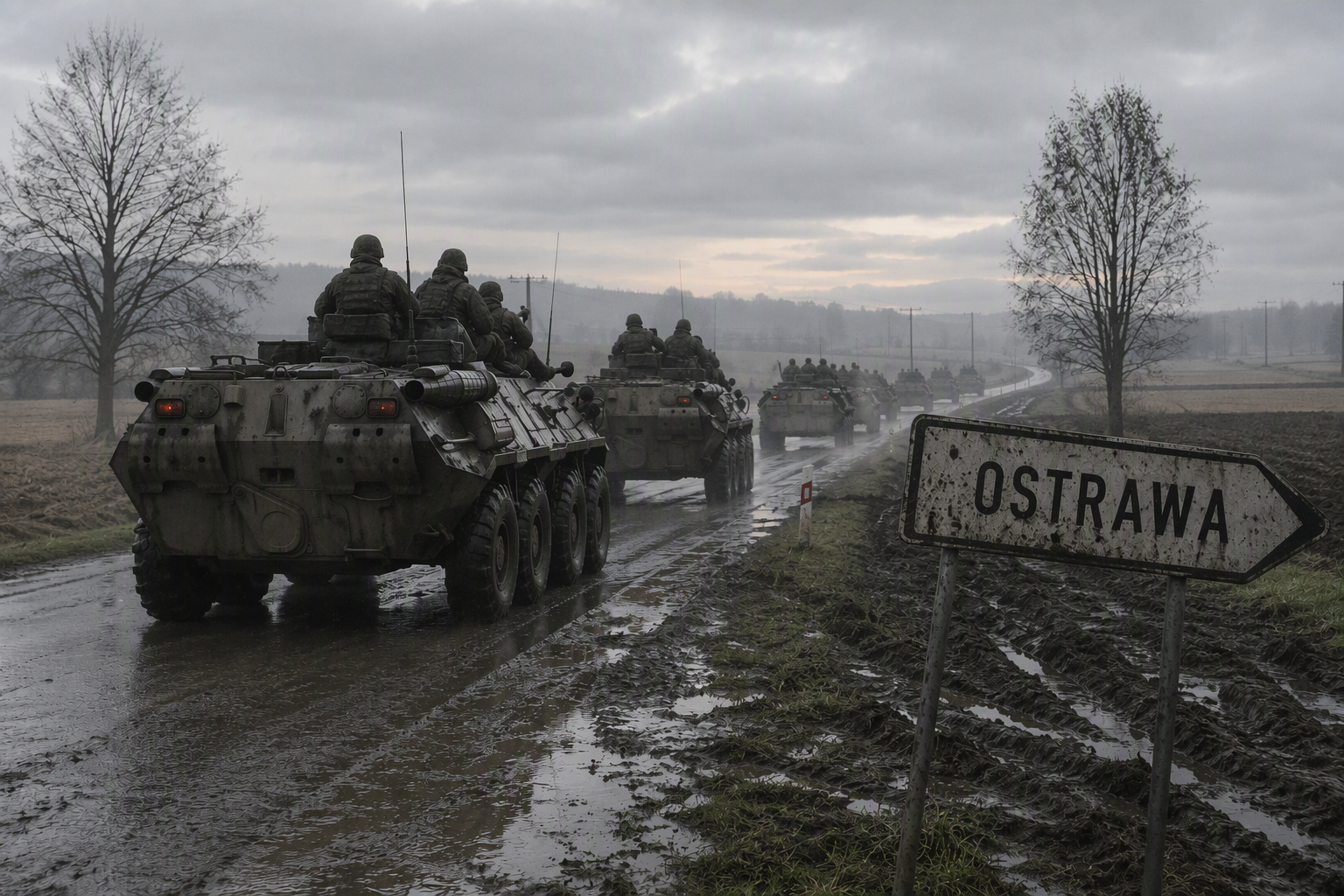
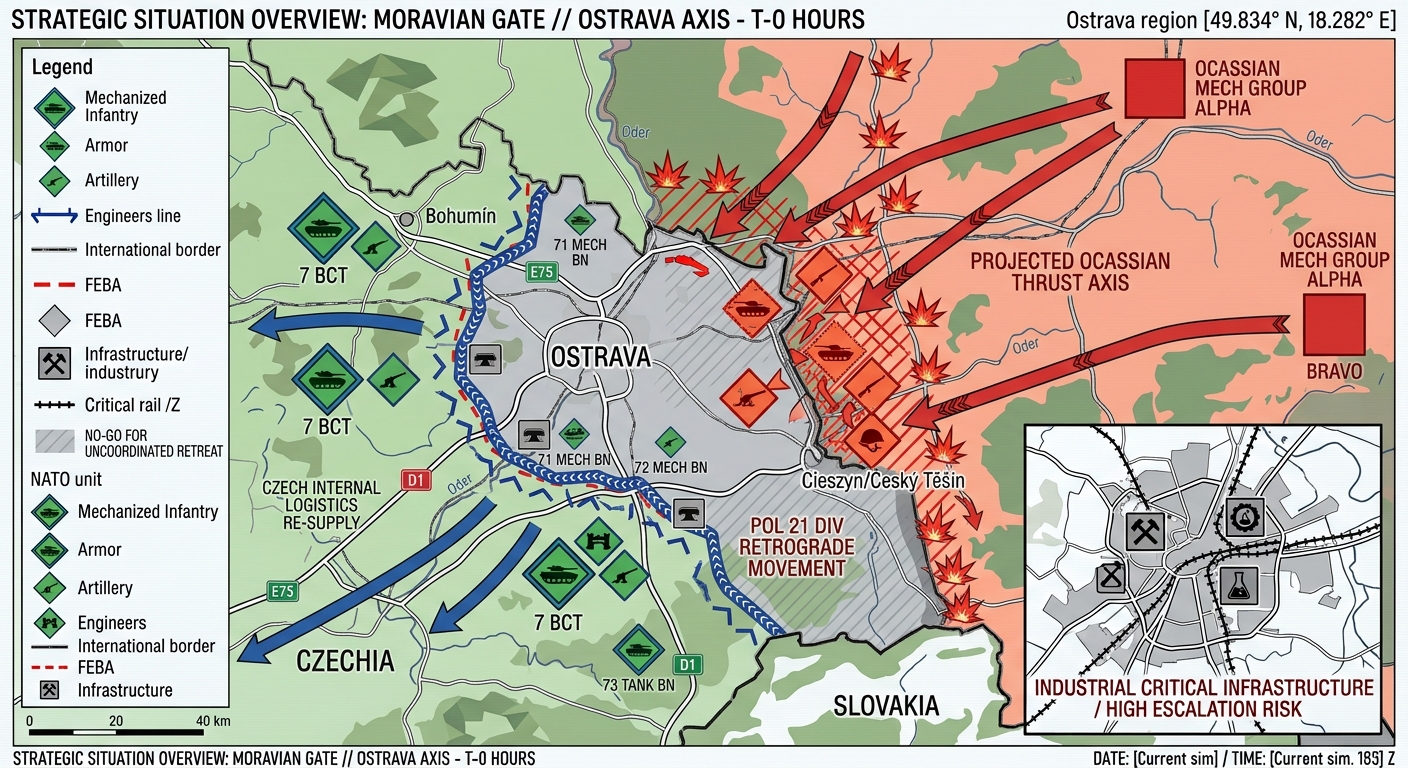
Satellite telemetry and traffic-pattern analysis confirm that remnants of the Polish 21st Division are conducting an coordinated retrograde maneuver in defense of Rybnik with possible retreat axis toward the Czech frontier, primarily along the Cieszyn/Český Těšín and Bohumín border nodes.
-
Unit Cohesion & Morale Index: Combat effectiveness has degraded significantly under operational pressure. Radio chatter indicates high command-and-control latency, depleted fuel stocks, and fracturing logistical cohesion.
-
Residual Lethality: Despite 2026-09-28T04:05:18+02:00psychological exhaustion, the division retains heavy anti-armor assets, infantry fighting vehicles, and portable air defense systems (MANPADS). A retreating formation forced into a geographic cul-de-sac presents an acute kinetic risk; desperate rearguard actions or accidental cross-border fire exchanges can quickly trigger unintended escalations.
Spatial Bottleneck: Czech 7th BCT Border Sector
The border perimeter is currently held by elements of the Czech 7th Heavy Mechanized Brigade (7th BCT). From a structural and terrain perspective, this posture carries severe tactical vulnerabilities:
-
The Moravian Gate Funnel: The terrain narrows sharply into the industrial corridor between the Western Carpathians and the Sudetes. This geometric funnel restricts defensive maneuver space.
-
Friendly Collision Risk: Integrating or filtering a collapsing foreign division through a static screen creates extreme target identification friction. If Polish units withdraw directly into the Czech defensive lines, they will disrupt line-of-fire clearance, create severe traffic jams along secondary roads, and paralyze Czech forward logistics.
-
Overextended Defense: The Czech 7th BCT is configured for territorial defense and heavy mechanized containment, not humanitarian containment or absorbing an entire dislocated friendly division under active pursuit.
Ocassian Offensive: The Ostrava Direction and Associated Risks
Ocassian operational planning is clearly massing for a breakout along the Ostrava axis. A multi-echelon push here is mathematically sound for an attacking force, but introduces structural dangers that will reverberate far beyond the tactical line of contact:
-
Collateral Destruction of Critical Infrastructure: The Ostrava conurbation is a dense web of rail freight yards, chemical processing plants, and energy infrastructure. High-explosive artillery prep or precision strikes targeting retreating logistics will inevitably trigger industrial contamination, sever the Trans-European rail corridors, and create severe local civil fallout.
-
Air Defense Saturation: As Ocassian forces launch long-range fires and drone swarms to interdict the retreat, low-altitude air defense systems of the Czech screen risk operational saturation. Radar clutter caused by high-density industrial buildings will generate high radar cross-section (RCS) blind spots, severely degrading radar tracking performance below 200 meters.
-
Precipitous Border Breach: If the Ocassian advance moves at high tempo to eliminate the retreating 21st Division, kinetic fires will inevitably spill across the Czech border line. Kinetic strikes impacting Czech territory will force direct engagement from the 7th BCT, escalating the conflict from an localized offensive into an inter-state operational clash with zero buffer remaining.
Assessment: The Ostrava axis represents an immediate operational flashpoint. The combination of Polish retreat, an immovable Czech screening force, and high-velocity Ocassian pursuit creates an operational bottleneck where tactical miscalculation is practically guaranteed. Defensive formations must prioritize establishing deep fire-coordination lines before the pocket collapses entirely.