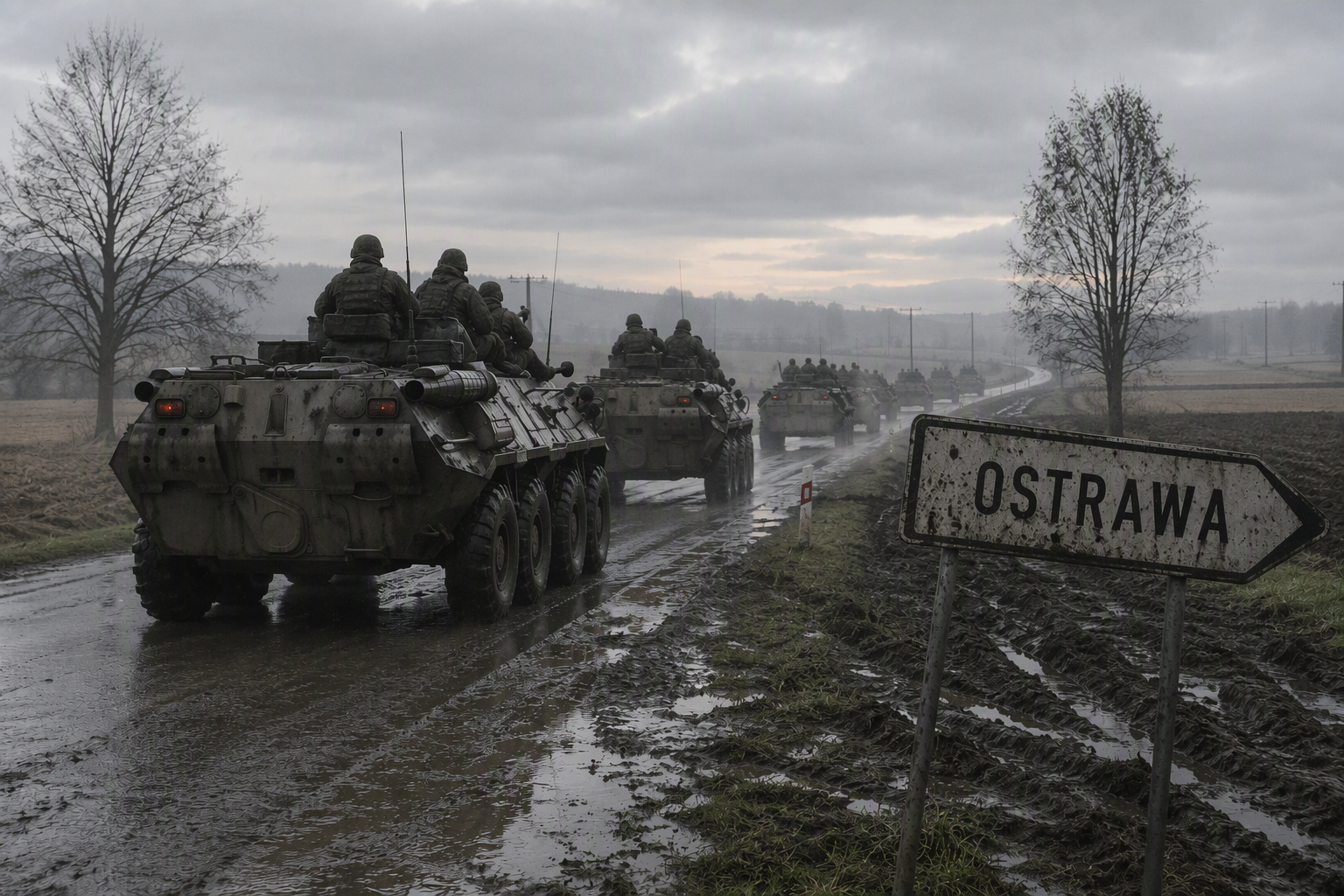
Front sector: Southern Polish Marches – Beskid Foothills / Subcarpathian axis
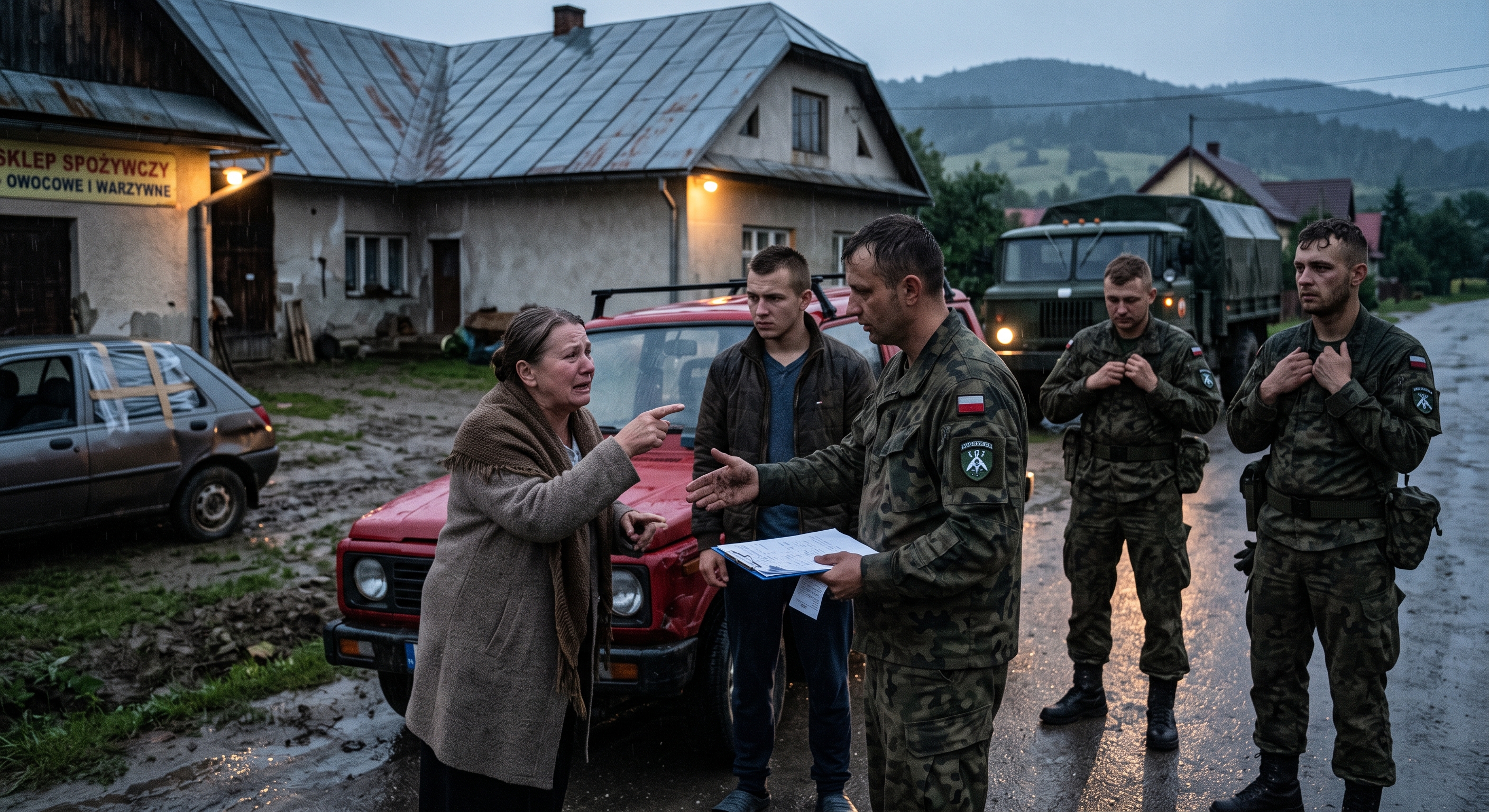
Front sector: Southern Polish Marches – Beskid Foothills / Subcarpathian axis
There is an old, bitter aphorism familiar to anyone who has studied the sociology of defeat: an army under strain ceases to see the local populace as the sovereign it protects, and begins to treat it as an operational obstacle.
Over the past seventy-two hours, signals intelligence, local civil communications intercepts, and field reports from our forward reconnaissance battalions tell an unmistakable story. In the sectors facing our southern thrust, the Polish 21st Division—standing on the historic mantle of the Podhale mountain tradition—is beginning to show profound symptoms of psychological and operational exhaustion.
It is easy for cheap triumphalists in the capital to point at this and declare an imminent collapse. But as an intelligence officer, I look at the downstream consequences. The disintegration of a military unit’s cohesion does not happen in a vacuum; it spills directly into the streets, the basements, and the farmsteads of the people caught between the lines.
1. The Anatomy of Attrition: Why the 21st is Fracturing
The 21st was designed and trained as the iron spine of Poland’s southern ramparts. Their identity is rooted in terrain defense, mobility through broken ground, and fierce regional pride. Yet modern warfare does not care about heritage when the structural fundamentals fail.
-
Logistical Strangulation: Our sustained interdiction strikes on the rail corridors and secondary bridges out of Tarnów and Rzeszów have turned their resupply into a trickle. Frontline units are rationing basic 5.56mm and 155mm allocations, while medical evacuation timelines have stretched from the golden hour to eighteen hours.
-
Thermal and Drone Exhaustion: The continuous presence of our loitering munitions over their trench networks has eliminated the concept of rest. Soldiers cannot light a stove, move a vehicle by daylight, or rotate positions without drawing precision mortar fire. Chronic sleep deprivation over three weeks destroys command judgment faster than enemy fire.
-
Command Decapitation: Rapid attrition among company-grade officers has forced inexperienced NCOs and mobilized reservists into tactical decision-making roles for which they lack both doctrinal preparation and psychological conditioning.
The result is predictable: cohesive tactical resistance is degenerating into localized survival instincts.
2. The Fracture with the Civilians: From Protectors to Requisitioners
When a combat division loses its logistical lifeline, its first victim is the civilian social contract.
In towns across the foothill valleys, we are seeing the classic, tragic signs of military-civilian friction:
-
Forced Quartering and Requisitions: Intercepted police band chatter and civilian messaging channels reveal rising outrage over Ukrainian-border corridor refugees and local Polish families being forcibly evicted from concrete cellars, commercial depots, and farm compounds so retreating infantry can establish hardened firing points. Private diesel stores, vehicles, and civil power generators are being commandeered by desperate logistical officers with little more than stamped chits that no bank will ever honor.
-
The “Fortress Settlement” Conflict: Local mayors and village administrators want to declare open corridors to evacuate women, children, and the elderly westward before our heavy artillery opens up. Fatigued junior commanders of the 21st, terrified of leaving their rear flanks exposed to our ISR drones, are increasingly restricting civilian movement, establishing arbitrary checkpoints, and blocking evacuation routes to prevent panic from choking military supply lanes.
-
The Erosion of Trust: In Subcarpathian villages that once welcomed these troops with hot soup and national flags, the sentiment has shifted toward cold, terrified resentment. Civilians see soldiers turning their homes into pre-sighted targets for our glide bombs. For the soldiers, every civilian who films a military truck on a smartphone or questions a fuel requisition is suddenly suspected of being an Ocassian reconnaissance spotter or saboteur. Paranoia has set in.
3. The Geopolitical and Strategic Cost
To our armchair tacticians in the capital, a breakdown between Polish troops and their population looks like an unalloyed victory. They think it means faster advances and less resistance.
They are blind.
Machiavelli warned that a prince who alienates the population in a war zone inherits not a secure territory, but an unmanageable desert of hatred. When defending units lose their moral footing and turn antagonistic toward their own people, they leave behind an embittered, militarized civilian vacuum.
If the 21st Division breaks and scatters into the hills, we will not be stepping into an orderly administrative landscape. We will be occupying a zone of shattered infrastructure, resentful populations who blame both their own abandoned military and us, and irregular groups armed with leftover anti-tank weapons who will fight from the basements not for the state, but for their own ruined livelihoods.
A retreating army that loses the love of its people becomes dangerous, unpredictable, and erratic. Our forward units must maintain extreme trigger discipline at checkpoints and respect humanitarian corridors. If we mimic the desperation of an unraveling enemy, we will simply inherit their failure.
The southern front is bending under the weight of steel, but the hardest war begins the moment civil order dissolves.
— Jastreb